When a 65-year-old woman from South Korea visited a medical clinic complaining of severe pain in both knees, doctors initially expected to find the usual signs of joint deterioration. However, what appeared on the X-ray was anything but ordinary.
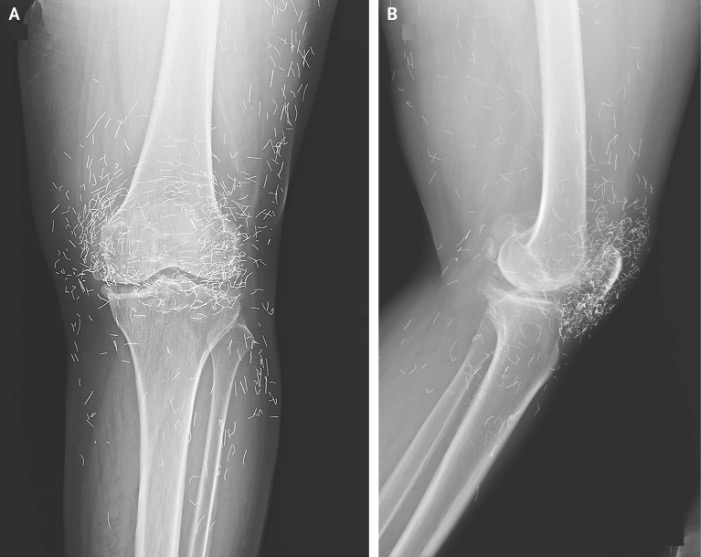
Scattered throughout the tissues surrounding both knees were hundreds of tiny, glistening gold fragments. These unusual metallic threads had been deliberately embedded in her joints, creating an extraordinary medical finding that immediately caught the attention of specialists.
The unusual case was later documented in the prestigious New England Journal of Medicine, highlighting the unexpected consequences of certain alternative medical treatments and the potential complications they can create.
Behind the discovery was a woman who had spent years searching for relief from chronic pain. Her experience offers a fascinating look at the intersection of traditional Eastern medicine and modern Western medical practices.
The Daily Struggle of Living With Osteoarthritis
To understand how hundreds of gold threads ended up inside a patient’s knees, it is important to understand the condition that led her to seek alternative treatment.
Osteoarthritis is a degenerative joint disease that gradually damages the cartilage protecting the ends of bones. As this protective tissue wears away, movement can become increasingly uncomfortable, often accompanied by stiffness, swelling, and persistent pain.
For this woman, everyday activities that most people take for granted had become increasingly difficult. Climbing stairs, bending down to tie her shoes, and even walking short distances could cause considerable discomfort.
She had previously tried conventional treatments, including painkillers and anti-inflammatory medications, hoping to regain some of her mobility.
Unfortunately, these treatments provided little relief. They also caused additional problems, including stomach pain and gastrointestinal discomfort.
After struggling to find an effective solution, she decided to explore another approach that had been practiced for centuries: acupuncture.
The Unusual Treatment That Left Gold Threads Behind
Acupuncture is a traditional treatment that involves inserting thin needles into specific points on the body. Practitioners use the technique with the aim of stimulating the nervous system and helping manage certain types of pain.
However, the treatment this woman received went a step further.
She underwent a specialized procedure involving the intentional implantation of tiny gold threads or needle fragments into the tissues surrounding her arthritic joints.
Unlike conventional acupuncture, in which needles are removed after treatment, this technique leaves the small metallic pieces inside the body.
The intention is to provide continuous stimulation to the affected areas over an extended period.
Although the practice has followers in several Asian countries, medical specialists have raised concerns about the potential complications associated with leaving foreign materials inside the body.
How the Human Body Reacts to Foreign Objects
One of the most important concerns surrounding this procedure is how the human body responds to materials that remain embedded in its tissues.
Dr. Ali Guermazi, a professor of radiology at Boston University who reviewed the case, explained that the body has natural defense mechanisms designed to respond to foreign objects.
According to his explanation, implanted materials can trigger inflammation, infections, and the formation of abscesses.
Foreign objects may also become surrounded by fibrous tissue as the body attempts to isolate them.
This reaction can create complications even when the implanted material is made from gold, a metal often considered relatively compatible with human tissue.
However, the potential problems do not end with inflammation or infection.
Hundreds of metallic fragments inside the knees can also interfere with certain medical examinations and make future treatment more complicated.
Why Gold Threads Can Complicate Medical Scans
One of the unexpected consequences of having metallic threads embedded in the body involves medical imaging.
Metal fragments can create artifacts or distortions in imaging studies, potentially making it more difficult for doctors to examine the underlying anatomy.
Magnetic Resonance Imaging (MRI) presents another important consideration.
MRI scanners use powerful magnetic fields and radiofrequency energy to produce detailed images of internal structures. Depending on the material, size, location, and properties of an implanted object, these forces can create safety concerns.
Dr. Guermazi warned that retained acupuncture needles could potentially move and damage nearby structures, including blood vessels.
For this reason, patients with implanted metallic objects must inform medical professionals before undergoing an MRI examination.
Not every metallic implant automatically makes MRI impossible. However, its composition and safety classification must be evaluated before scanning.
A treatment originally intended to provide long-term pain relief can therefore introduce additional considerations when a patient needs modern diagnostic care.
Acupuncture: A Global Practice With Millions of Followers
Despite ongoing medical discussions about its effectiveness and potential risks, acupuncture remains widely practiced around the world.
Its popularity is not limited to East Asia. Millions of people in the United States have also explored acupuncture as an alternative or complementary approach to managing pain and other health concerns.
Historical figures from the U.S. National Institutes of Health’s National Center for Complementary and Integrative Health have reported that approximately 3.1 million American adults and 150,000 children had used acupuncture.
However, it is important to distinguish between conventional acupuncture, in which needles are removed after treatment, and procedures that intentionally leave metallic materials inside the body.
The evidence supporting acupuncture varies depending on the condition being treated, and it should not be considered a proven cure for advanced osteoarthritis or structural joint damage.
Patients considering alternative treatments should discuss their options with qualified healthcare professionals and understand the possible benefits and risks.
A Medical Discovery That Raises Important Questions
For the 65-year-old South Korean woman, the discovery of hundreds of gold threads in her knees revealed an unexpected consequence of her search for relief from chronic pain.
Her case illustrates how far people may go when conventional treatments fail to provide the comfort they desperately need.
It also highlights an important lesson about alternative medical procedures: treatments that appear harmless or traditional can sometimes introduce complications that remain hidden for years.
The golden fragments inside her knees were certainly an unusual discovery, but their presence also reminded doctors of the importance of understanding everything a patient has previously undergone.
Ultimately, the story is about more than an extraordinary X-ray image. It is a reminder that every medical decision deserves careful consideration, especially when a procedure involves leaving foreign materials permanently inside the human body.
Leave a Reply